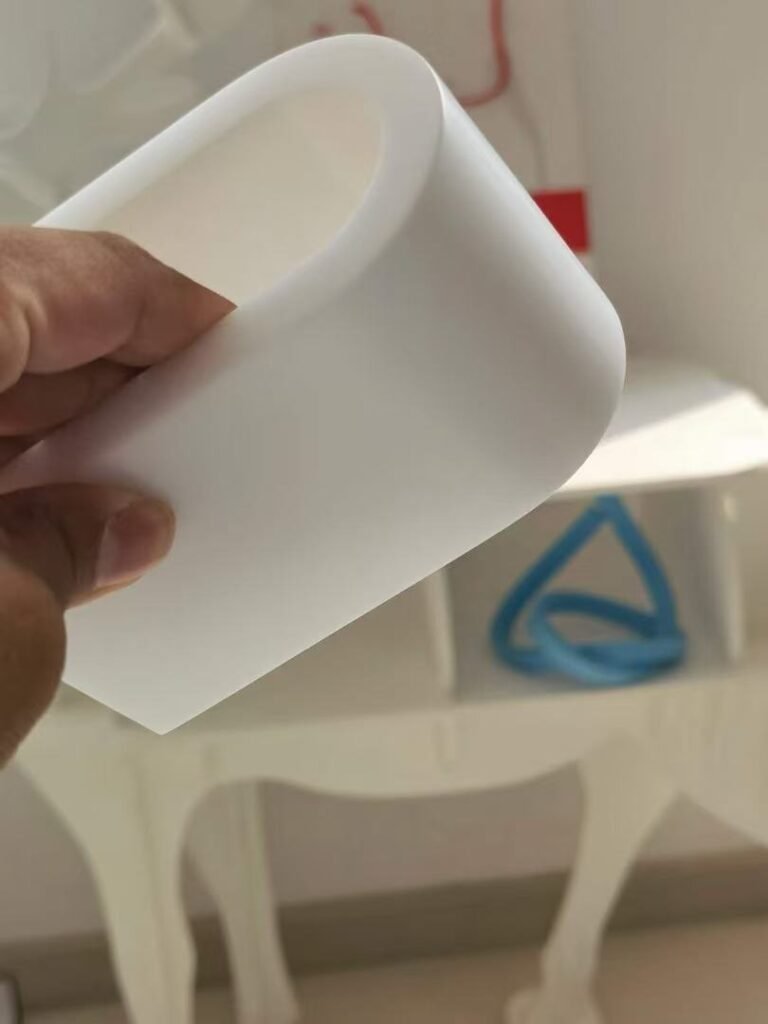
Acrylic solid surface can be thermoformed into curved components, but a drawing needs material-specific review before a radius or process can be promised. Thickness, colour, resin grade, pattern and equipment all influence the result.
Define the curve precisely
Provide the finished inside radius, component dimensions, thickness, tolerances, colour and final finish. A bend angle and a bend radius describe different things: a “near-zero angle” does not prove that a sheet can form a sharp radius without damage. Include nearby cut-outs, seams and attachment points in the drawing.
Choose the exact material before testing
Pure acrylic and modified acrylic products should not be treated as interchangeable for forming. “100% acrylic” refers to the resin system; it is not a guarantee of a particular temperature or minimum radius. Request the selected grade’s fabrication instructions and confirm whether the colour or pattern has additional limitations.
Approve a prototype
- Use representative material of the specified grade, colour and thickness.
- Validate heating, moulding and cooling using the product guidance and the fabricator’s equipment.
- Inspect for whitening, cracks, distortion, springback and pattern changes.
- Check the dimensions and fit with adjoining parts after cooling.
- Record the accepted sample and process before a production order.
Design joints and installation together
A curved face may still need joints. Plan seam locations, adhesive compatibility, support and installation access. Inconspicuous joints depend on colour, pattern and workmanship; they are not guaranteed to disappear. Thermoformed shower trays or basins also need their drainage, support and intended-use requirements reviewed.
Evaluate an alternative product
A material proposed instead of a named brand needs the designer’s approval. Similar ingredients do not prove identical performance or certification. Compare the actual sample, required documents and fabrication trial, along with the complete delivered and fabricated cost.
Read the fabrication guide and pure versus modified acrylic guide. Send KSTONE the curved-component drawing for feasibility review and sample planning.