Do Solid Surface Basins Always Need Male and Female Moulds?
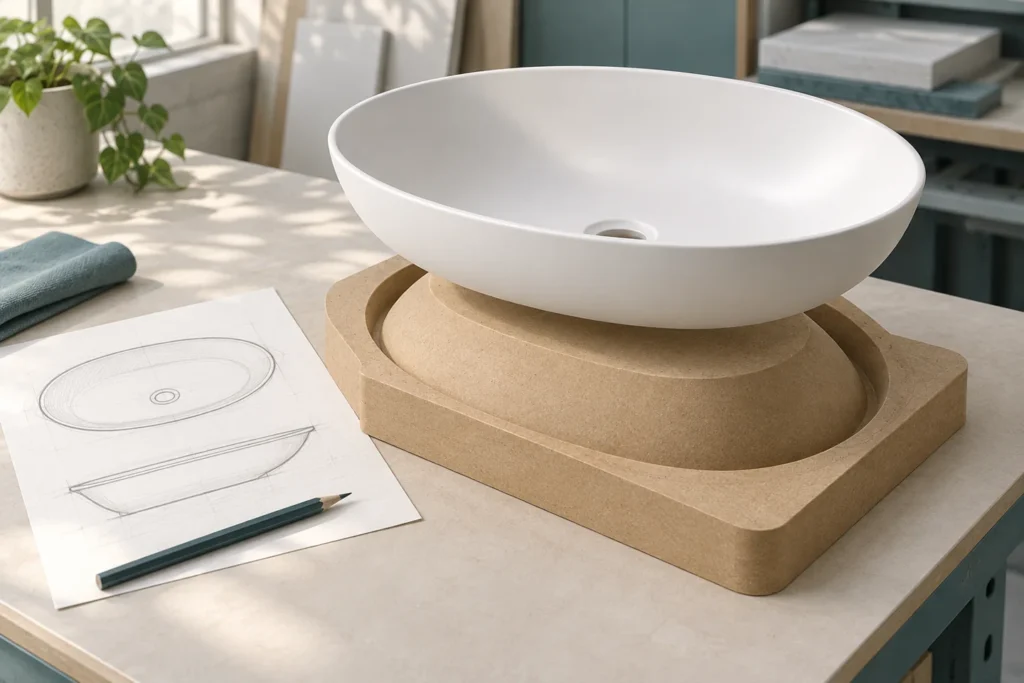
Illustration above: conceptual basin tooling, not a production photograph or a dimensioned mould design.
When ordering solid surface basin moulds, a basin drawing may be approved, a tooling price arrives, and one question remains: does the quotation include the mould you actually need?
“Basin mould” can mean a single forming tool, a matched set, a trimming fixture—or even be misunderstood as a finished basin. Before comparing prices, agree what the supplier is making and how you intend to use it.
A male-and-female mould set is not a universal requirement. The appropriate configuration depends on the forming equipment, basin geometry and surfaces that need to be controlled.
Understand what each tooling option does
A male mould has a projecting shape over which the sheet is formed. A female mould has a cavity into which it is formed. A matched set uses opposing tool surfaces. The familiar labels “positive” and “negative” are not enough for a purchase order: include a section drawing showing the sheet and tool contact surfaces.
Corian’s technical guidance describes male, female and matching mould arrangements, and notes that vacuum membrane presses often use single-sided moulds. That supports an important distinction: a single mould can be a valid configuration, but it is not automatically suitable for every basin or machine.
| Proposed arrangement | What the buyer should establish |
|---|---|
| Single-sided mould with a vacuum membrane press | Confirm machine compatibility, forming access and which surface the tool controls. |
| Matched tooling | Ask why both surfaces are needed and how the tool accommodates the sheet during forming. |
| Forming tool plus separate trimming fixture | Identify which operations each item supports; the trimming fixture is not necessarily a second forming mould. |
Start with the process—not the basin name
“Countertop basin” describes how a finished basin is installed. It does not specify the tooling arrangement.
Give the toolmaker your machine type, usable working area, forming method and intended production sequence. Explain whether you will form a bowl, fabricate separate sections, or combine formed and bonded parts. Casting a basin from a liquid mixture is a different process from forming an existing sheet; tooling proposals for the two should not be compared as if they were interchangeable.
The toolmaker and equipment supplier should review the proposed arrangement together when compatibility is uncertain. A photo of a similar basin is a starting point, not a tooling specification.
Identify which dimensions matter after forming
Mark the dimensions that determine installation and function: internal bowl size, external envelope, rim interface, drain position and any connection to a countertop or cabinet.
State whether each dimension refers to the finished surface, the formed blank or the tool itself. Do not assume that the CAD dimensions of a mould will automatically become identical finished-part dimensions. Discuss sheet thickness, forming behaviour, trimming and finishing allowances before machining the tool.
For a new design, ask the supplier to show:
- A section through the proposed tool and sheet.
- The surfaces and dimensions controlled by that tool.
- How the formed part will be released and supported for the next operation.
- Which features will be trimmed, machined or bonded afterwards.
Choose tooling material for the production plan
MDF and other wood-based materials are used for solid surface forming tools, but suitability depends on construction, surface preparation and intended use. Corian’s guidance also discusses tool finish, repeated heat exposure and alternative tooling materials.
Instead of asking only “Is it solid MDF?”, ask what production quantity the proposal is intended to support, how the surface will be prepared, and what maintenance or replacement may be required. Obtain a tool-life commitment only if the supplier can define its operating conditions and acceptance criteria.
For repeat orders, also record tool ownership, identification, storage location and who may authorize modifications.
Approve a formed trial before releasing production
Where a production trial is included, use the agreed material grade, colour and thickness. Check the cooled component against the drawing, inspect its visible surfaces and confirm fit with the actual drain fitting or adjoining part where relevant.
A successful trial should answer two separate questions: does the tool work with the intended equipment, and does the resulting component meet the agreed requirements?
Record any changes before another trial. If the material or process changes, decide whether the original approval still applies. Avoid accepting a universal forming temperature or radius simply because it worked with another product.
Put the complete tooling scope in the quotation
Before ordering, obtain written answers to these questions:
- Are we buying finished basins, forming tools, or both?
- How many forming tools and separate fixtures are included?
- Which drawing revision and machine configuration are approved?
- Are trial forming, finishing and sample delivery included?
- What happens if the tool fails the agreed trial—and who pays for modification, retesting and transport?
If a trial fails, compare the tool, material, equipment and actual process with the approved brief before deciding the cause. A design change and a tool made incorrectly are different situations; agree the remedy and revised approval in writing.
KSTONE works with solid surface materials and custom fabrication. For a tooling enquiry, send the basin drawing together with the intended forming method and machine information so the scope can be reviewed before quotation.
Related reading: Reviewing a curved solid surface design · Custom fabrication services
Technical reference: Corian® Solid Surface Thermoforming — Fabrication/Installation Fundamentals, especially the mould sections. This is Corian-specific guidance, not a processing specification for KSTONE or other brands. Use the selected material’s instructions and a representative trial.
Contact KSTONE with your drawings and project requirements to discuss the appropriate scope.